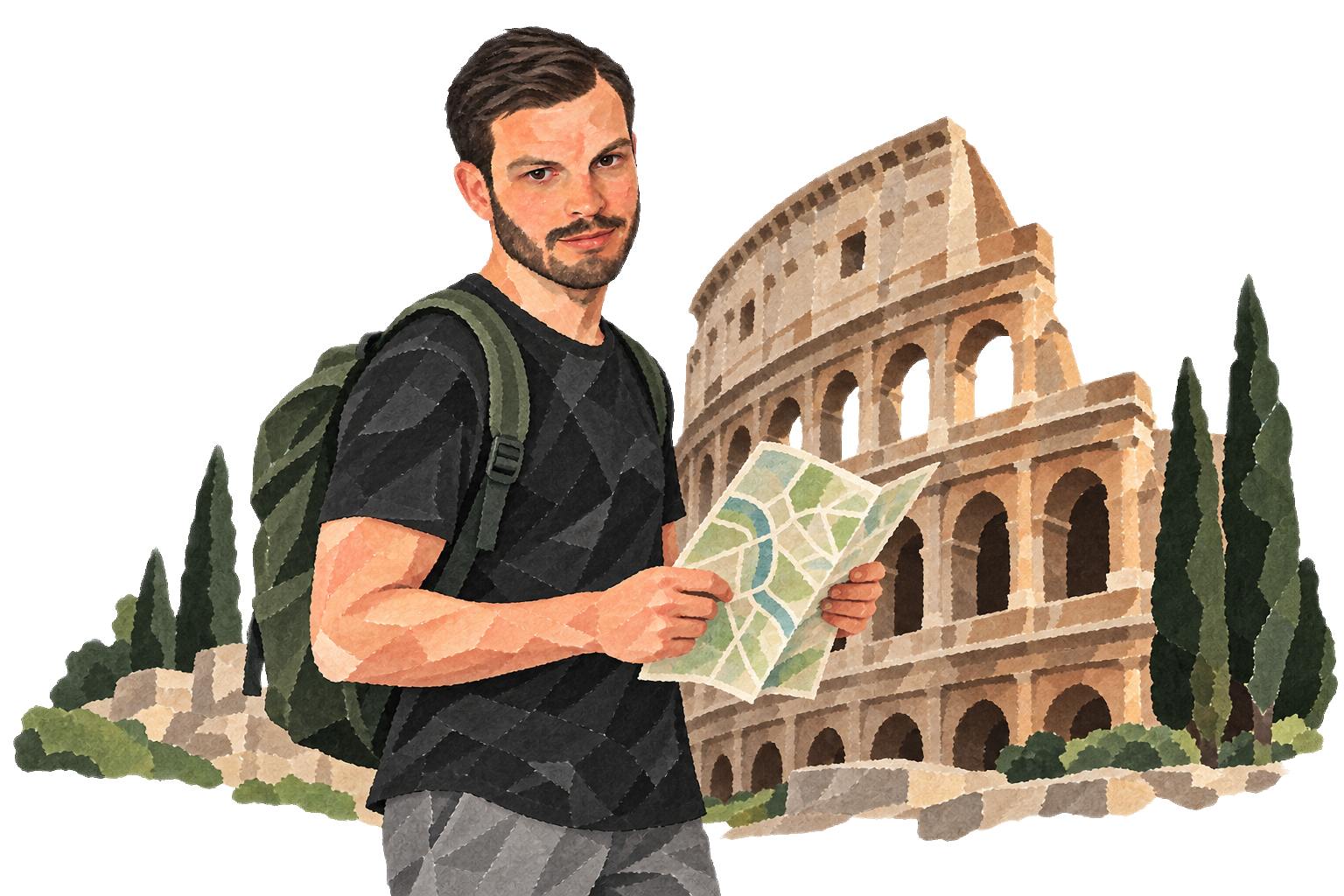
For me, autumn is the best time to visit southern Europe. Daytime temperatures can reach around 25°C—ideal for exploring a city—while cooler nights make it easier to sleep. This year I went to Italy to visit its capital, Rome, and the smaller southern city ofLecce. This article is about the capital: an open-air museum.
https://twitter.com/gijsheerkens/status/1187355600352632832
One bonus of learning Spanish is that I can understand parts of other Romance languages—Italian, Portuguese, Romanian, and French—and communicate a little. That comes in handy when I travel somewhere where I cannot always rely on English. Let’s start with a few basic words in Italian:
- hi – ciao
- bye – arrivederci
- thanks – grazie
- you’re welcome – prego
- how are you? – come stai?
- ok – va bene
- yes – sì
- no – no
- sorry – scusa
- please – per favore
Rome is one of the oldest cities in the world and was founded long before the Common Era. Its many ancient landmarks make it feel like an open-air museum.
Here are the things that struck me most about Rome:
- Italians know their food
- Cash is still common
- Traffic is hectic, and public transport has its limits
- There are thousands of cafés, but few welcome laptop workers
- Ancient buildings make the city feel like an open-air museum
Gastronomy
You do not need to teach Italians about food. My Italian friends all seem to consider themselves kitchen experts, and they may have a point.
In Rome, you can eat lasagne or a pizza in a simple restaurant for around €5 and still get a good meal. Desserts such as tiramisu are tasty and affordable too.
But do not ask for a Hawaiian pizza!
https://twitter.com/gijsheerkens/status/1194690416043364352
I used to associate Italian longevity with healthy food choices, though I am less sure after seeing some of the plates here: plenty of pasta and dessert, often with wine on the side. And then there is Nutella, one of Italy’s best-known exports.
The city is full of coffee bars. “Un espresso, per favore.” Many Italians seem to be in and out in about a minute: order at the bar, drink, pay, and leave. I took a little longer. Be aware that sitting down can cost more than drinking at the counter.
Cash
Italians seem attached to cash. On average, they keep 65 euros in their pockets. In hotels, supermarkets, and bars, people often pay with cash by default. You may need to ask to pay by card. Cash transactions can be harder for governments to track, which may be one reason cash remains popular.
Transport
Rome’s streets are packed with cars and impatient drivers leaning on their horns.
The metro has only three lines, which meet at Termini station. Construction is slow partly because the ground is so rich in archaeology: work must pause whenever an important site is found.
I was lucky that Uber launched its electric bike-sharing service, Jump on the day I arrived. The bikes were expensive—€4 an hour—but they were a convenient way to explore. Cycling did not seem common yet; I often felt like the only person on a bike, just as I had in Bali.
Working
Rome did not seem especially ready for digital nomads when I visited. Free public Wi-Fi was uncommon, though that did not bother me because I prefer to work at home. Café staff did not seem keen on customers opening a laptop to work, either.
Sightseeing
Bring a camera to Rome. The city is full of reminders of the Roman Empire.
I would make time for at least these sights:
- Colosseum
- Forum Romanum
- Pantheon
- Trevi Fountain
- Vatican City
- Monument to Victor Emmanuel II
- Spanish Steps
Dit bericht bekijken op InstagramEen bericht gedeeld door Manual Focus | @landscape_mf (@landscape_mf) op
My Rome song
I choose one song to represent my memories of each place I stay. For Rome, it is Eros Ramazzotti’s Se bastasse una canzone, one of the few Italian songs I know.