Appearing in local search results is a major challenge for online shops. I struggled with it for years for my online passport photo solution, but now I seem to have found a solution. It turned out that local competitors could also become long-tail search opportunities.
I managed to obtain great positions in Google by focusing on long tail SEO from day one. Ten years of work have paid off. SEO is a long-term game in which the compound effect greatly applies.
But local SEO is a different ball game. Below the Google Maps results that appear at the top of most local searches (e.g. "passport photo amsterdam"), there is still plenty of room to compete.
Since my service targets customers in the Netherlands, I created landing pages for all Dutch cities, such as Amsterdam, Rotterdam, The Hague, Utrecht and Eindhoven.
These city pages target broad search phrases on the combination of the product and the city (e.g. "passport photo amsterdam"), and bring me a fair amount of visitors on a daily basis.
This is what a search results page looks like (below the Google Maps rich snippet) for such a broad search phrase combination, for the city of Eindhoven, the fifth-largest city in the Netherlands.
But I felt like there was more to it.
Keyword research showed that most local searches are on neighborhood level (e.g. "passport photo amsterdam center"). Hence, many people use long-tail keywords.
As long as you stay relevant for users with your content, the page has added value and is likely to rank on the keywords you target. So the fact that people are using keyword combinations with neighborhood names means that pages on this specific topic will be relevant.
I thought pages about individual photographers, with neighborhood names in the content, could be relevant to these searches.
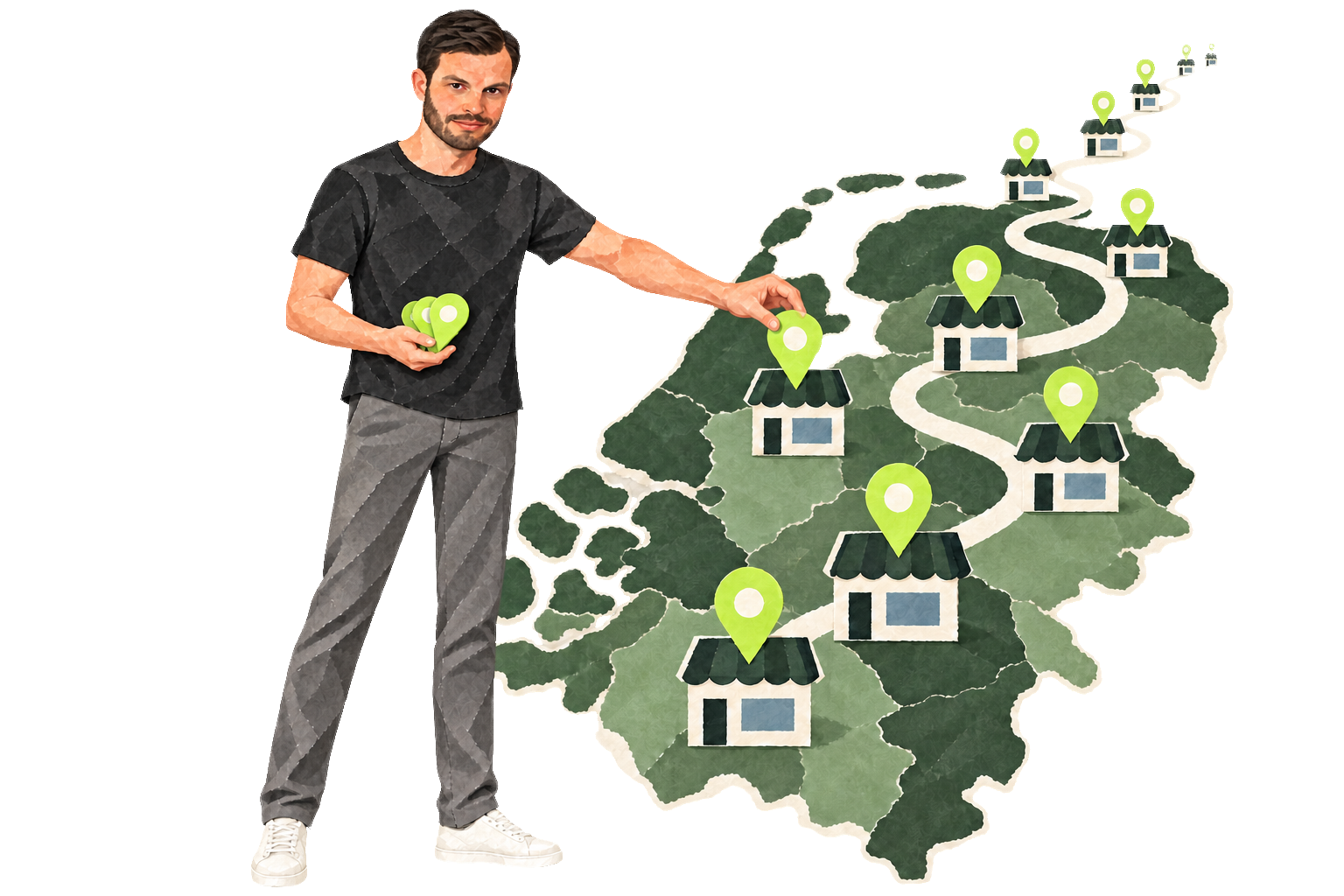
So I listed all my offline competitors on my website, starting with six cities as a test. After two months the results are very promising, as the number of visitors per city has increased fivefold.
The SERP for a long tail search phrase including an area name looks like this.
I placed these listings at the right level in the site hierarchy so visitors and search engines could navigate them easily.
- Home (level 1): https://pasfoto.nu/
- Cities (level 2): https://pasfoto.nu/maken/
- City (level 3): https://pasfoto.nu/maken/pasfoto-eindhoven/
- Photographer (level 4): https://pasfoto.nu/maken/pasfoto-eindhoven/zwaan-fotografie-eindhoven-centrum/
Notice the emphasis I put on the area name in headers, page titles and content within these listing pages.
On these pages, I compare each competitor’s price with that of my online service, highlighting the customer's saving opportunity.
A big advantage here is that the product is homogeneous. This might be a bit harder if you sell several products, but you get the idea.
This is what a listing page looks like now. Notice how the saving opportunity and CTA button are standing out.
It might feel contradictory to list your competitors within your own website (for free), but don't forget that it's an excellent way to attract visitors you otherwise wouldn't attract.
Some of them might go to the offline competitor, but they probably searched for an offline solution anyway. The goal is to seduce the rest of them to use my online services. You aren't going to win the complete market anyway.
The photographers get listed free of charge for now, although there are listing sites that charge money for it while ranking below me. So I might even charge for it in the future as an extra business model.
Listing photographers across more than 100 cities is a huge job, but the long-term results could be worth it; pages that bring visitors every single day.
You know you need to be obsessed to accomplish success, right?