Thanks to the Thai calendar, I landed 543 years in the future—and in Bangkok heat that reached 48 degrees Celsius. The city felt overwhelming and chaotic. It was a real culture shock for me.
This was my first time in Asia. Some friends had warned me that I might find parts of the trip noisy and disorderly. As a quiet and organised guy, I did find the adjustment hard, but I am glad I experienced it for myself. I do not think I would make the same trip again.
Bangkok, in particular, was difficult for me: enormous, crowded, hot, and hard to navigate on foot. Traffic felt risky when I tried to cross the road, and hazardous air quality sometimes rose above 200. A traffic jam could turn a short journey into hours, so sightseeing was not especially relaxing.
Over six weeks in Thailand, I spent about one week in Bangkok and five in Chiang Mai, the country’s second-largest city in the north.
Chiang Mai felt calmer. I stayed in Nimman, an area associated with the early digital-nomad scene.
At passport control, an officer asked what I planned to do during my stay. “Go on holiday,” I said.
At the time, my Dutch passport allowed me a 30-day visa exemption on arrival. I extended it once for another 30 days at an immigration office, for about €50. The queues were long and the process hectic. I stayed 45 days in total.
Three things helped me after arriving:
- I installed Grab, an app similar to Uber, and used it often. It was convenient and inexpensive.
- I bought a local SIM with unlimited data. Mine was from AIS and cost €25 for a month. It was useful as a hotspot when the Wi-Fi was unreliable.
- I withdrew cash because I often needed it. At the time, ATMs charged 220 baht (about €6) per withdrawal, so larger withdrawals meant fewer fees.
Tourist
I worked in plenty of cafés. I especially liked Wild Coffee & Bistro (in the jungle), while Pan Yai Yan was the most convenient.
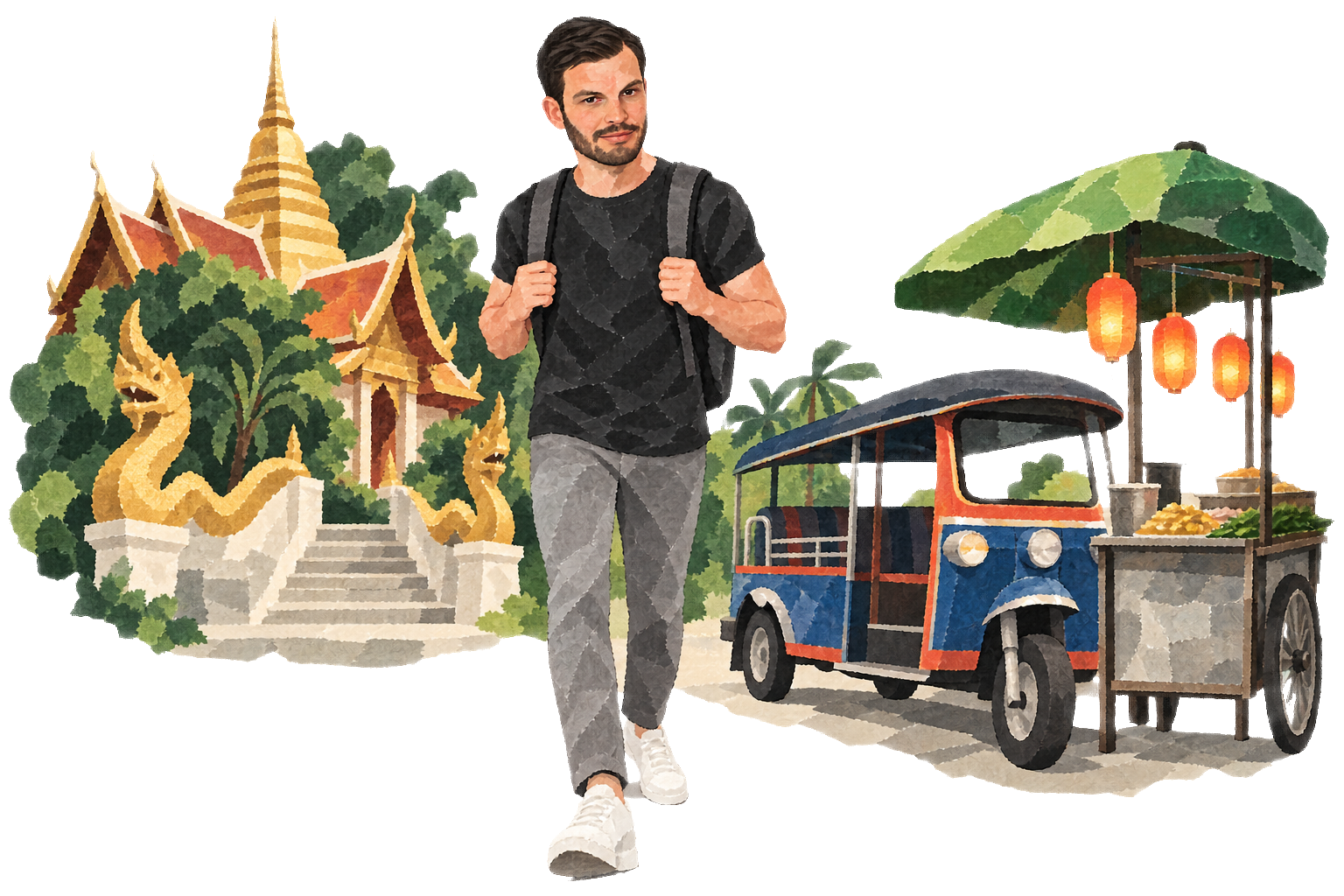
I also did the tourist things:
- I fed an elephant at a sanctuary.
- I visited the northern hippie town of Pai for a few days.
- I visited Doi Suthep temple on top of the mountain.
- I ate street food.
- I climbed up the Huay Kaew waterfall.
- I watched live Thai boxing.
- I had a Thai massage (without a happy ending).
- I rode in a Songtaew (but skipped the tuk-tuk).
Street food and restaurants
I like cooking, but in Thailand I rarely saw a reason to. Meals were inexpensive, while groceries often cost more than I expected. For 20–30 baht (about €0.50–€0.75), I could buy a street food meal. I looked for busy stalls, where food seemed less likely to have been sitting out for hours in the heat.
I watched how food was prepared and did not get sick during my six weeks there.
Traditional Thai restaurants were another option. Meals often cost 40–80 baht (€1–€2). I checked reviews before visiting a place.
Western-style restaurants were also common and generally cost 100–200 baht (€3–€6) for a meal. They often felt more familiar to me.
I ate out more than 100 times during the trip. Eventually, even that became repetitive. I had had enough noodles and rice.