
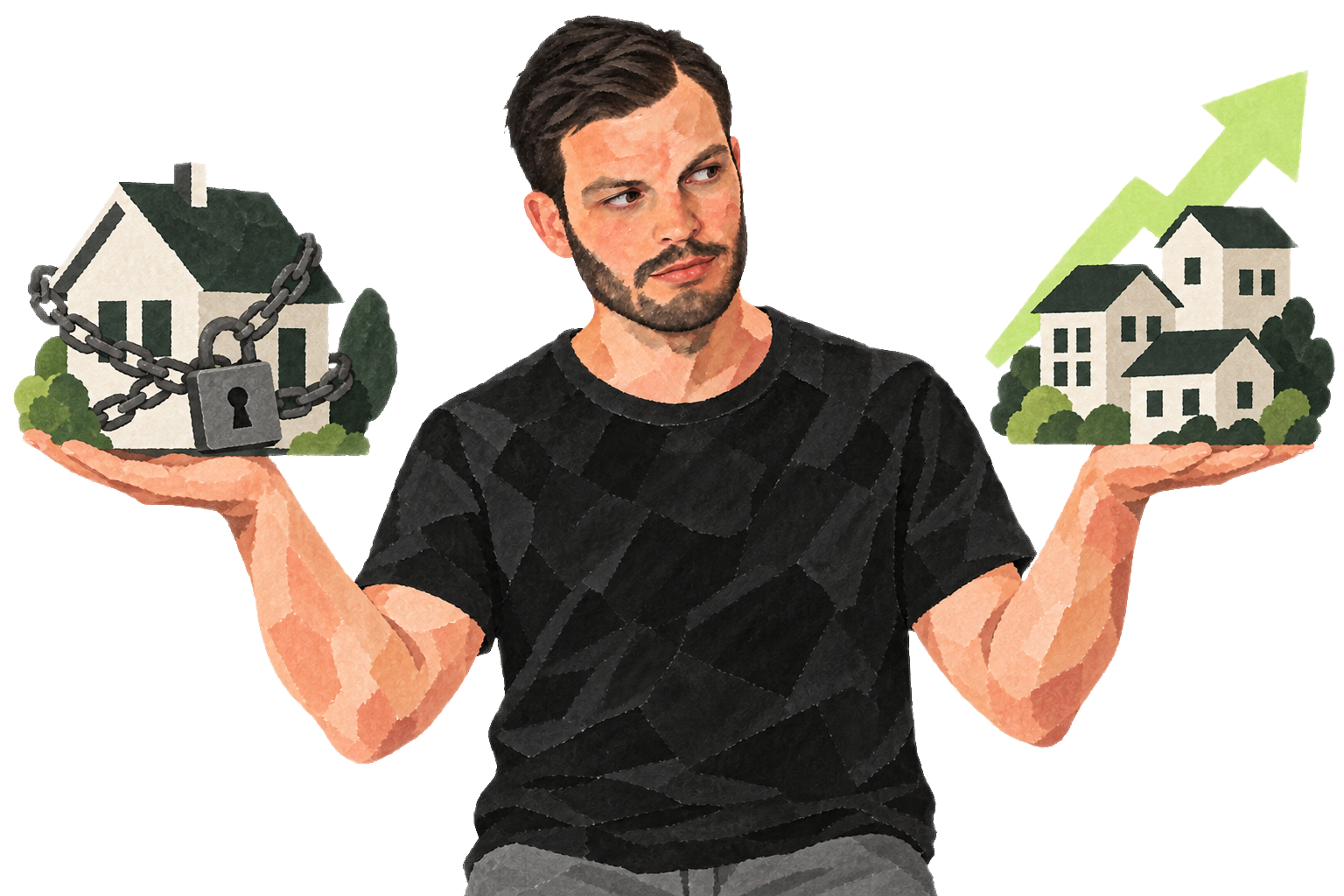
Society tells us that we should live in the house we own. But it often doesn't make sense. Yet buying a first home is still treated as proof that you’ve made it. Owning property can make sense, but living in the property you own is a separate decision.
Buying a house is probably the biggest financial transaction in your life. Buying a home to live in, often with a partner, brings up a lot of emotion. Those emotions can cloud a financial decision.
If you want to buy a house, treat it as an investment decision, not an emotional one.
https://twitter.com/levelsio/status/1136888945373933568
I just read Robert Kiyosaki's classic book Rich Dad Poor Dad, which reinforced my thinking on this topic.
Kiyosaki had two dads. His real father (poor dad), a highly educated man with a good job, told him to study and find a well-paying job to be able to buy a house, his stepfather (rich dad), an entrepreneur and investor without formal education, told him to get financially literate in order to look for assets that make money work for him.
He decided to follow his rich dad.
This author also developed the cashflow quadrant. On the left side of this quadrant are the employees (people that have a job) and the freelancers (people that are a job), on the right side are the entrepreneurs (people that own a system) and the investors (people that make money with money).
In Kiyosaki’s framework, people on the left work for money, while those on the right make money work for them. If financial independence is your goal, he argues, moving to the right side early gives you more time. Don't forget to watch the video.
Our society has encouraged us to learn a profession so we can work for money, but failed to teach us how to have money work for us. The vast majority of the Western world subscribes to this dogma, simply because it's easier to find a job and work for money than to take risks and get rich. These are the same people that tell you to not rent a house.
A house you live in is not an asset but a liability, because it doesn't make you money. If you pay for it every month and it brings in no income, it may not be a good investment. Rich people acquire assets while the poor acquire liabilities that they think are assets.
A property you rent out can be an asset when its income exceeds the mortgage and other costs. A mortgage is a way to leverage your investment and its returns, and helps you to start becoming an investor early in life, which makes a gigantic difference due to the compound effect.
In most countries you have to bring a minimum percentage of own money to the table to get a mortgage for investment property. Based on the savings you have, you can calculate what your first investment can be. You could start with something as small as a storage unit, as long as you can rent it out with profit.
After that, you can refinance your first property and use it as collateral for your next one, and build a portfolio like that. The first property of a portfolio is the most important and the hardest one, that's why it's crucial to start early.
But you have to live somewhere, right? It's highly improbable that this will be the same place for thirty years, the length of a standard mortgage. If you leave earlier it's uncertain if your property's value has increased, which usually is a long term effect.
If the value has increased, it's probably because of inflation, and the price of your new house has also increased, eating your profit. And you have to pay all the additional costs again, like notary, taxes and renovations.
If you are renting your home while building your portfolio, in the beginning you may break even or even make a loss, while buying a home would lower your monthly expenses at that moment.
I understand it seems obvious to go for the latter in that phase, as it's hard to think long term. But the compound effect applies greatly here.
I don’t accept the idea that renting is simply throwing money away; agents and banks have incentives to encourage buying. The financing system often serves banks as much as homeowners.
Renting gives you freedom, which is my most important life value. You might change jobs, cities, relationships or have children. Renting allows you to adapt quickly to a new situation.
Your home, neighbors, neighborhood, or city might not be what you expected. People split up all the time, and move on average every seven years because of changing stages of life. Besides, you get lots of protections as a renter.
My approach is to rent the home I live in while building income-producing assets, rather than relying on work to cover every liability.