To work toward financial independence, I first needed a clear income target. Once I accounted for taxes, expenses and investing, the number was much higher than I expected.
I thought my business was doing well. Then I watched the video below by Grant Cardone and reconsidered my target.
A comfortable income may still fall short of what you need to leave the rat race.
My aim is an income that covers my bills and lets me invest 40% of the gross amount toward future freedom.
I want to invest aggressively in real estate, index funds and other assets until those assets can replace my working income.
Roughly 40% of your income goes to income taxes, and you might want to invest the same amount of money in your own future as in your country's.
Take my budget as an example: €2,000 in monthly expenses.
If I want to invest 40% of my gross income, I have to multiply the expenses by 5 to set the right income target.
On that calculation, I would need €2,000 × 5 = €10,000 a month.
That is, if I were an employee or freelancer that works for money, the left side of the cashflow quadrant. When these people stop working, their income from work turns to zero.
I see myself on the other side of the cashflow quadrant, alongside entrepreneurs and investors who build income-producing systems.
I built a system that generates income without having to put in time. I have always instinctively worked to get there, even before I knew the cashflow quadrant theory.
This system will still exist when I retire, so this will generate a part of the monthly income I'll need in the future. That means I may need to earn less now than someone whose working income will stop entirely at retirement.
This is yet another important reason to try to get to the right side of the cashflow quadrant as soon as possible.
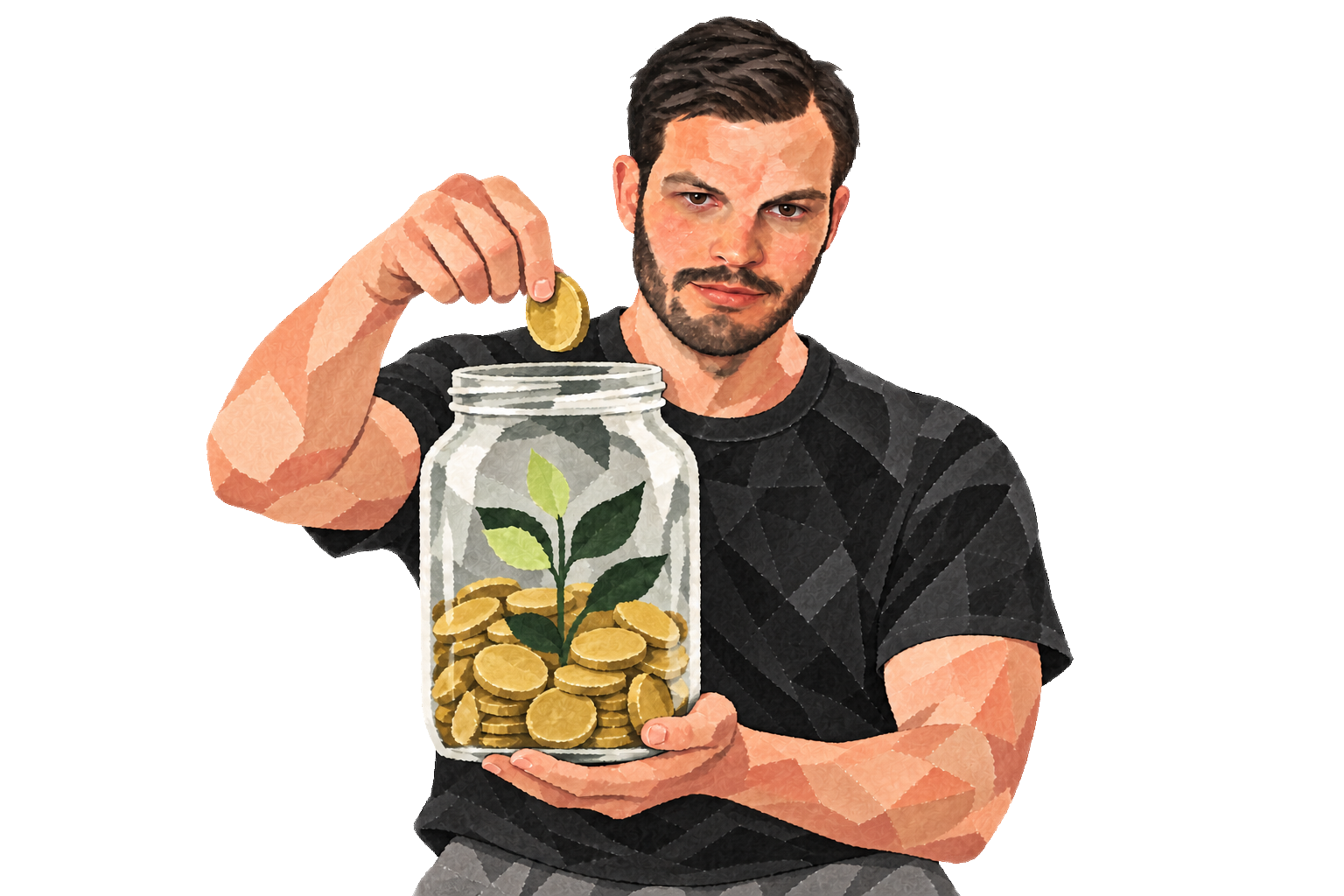
Paying yourself first is a mindset.
It puts investing near the start of the monthly budget rather than leaving it until the end. You pay your future self before you pay taxes and your current self.
This creates external pressure to earn enough income to be able to pay your taxes and your bills, and makes it feel more of an obligation.
If I leave investing until last, it is easier to skip when other expenses appear.
Living frugally and avoiding things I do not need are central to this strategy. Cutting down my expenses to €1.500/month will have a significant impact on my targets; €1.500*5= €7.500 gross income = €9.375 MRR.
In this example, reducing expenses by €500 a month lowers my stated monthly target by €3,125. Cutting costs has a large effect on the goal. For every € you spend more, your target increases with €5.
Yet another reason to own less stuff, don't buy a car and not own a house to have more freedom to save money when necessary.
This is a completely different mindset than society's default; spending everything we earn because we have a good salary, meanwhile not thinking about our own future.
That habit would make it much harder for me to reach financial independence.