
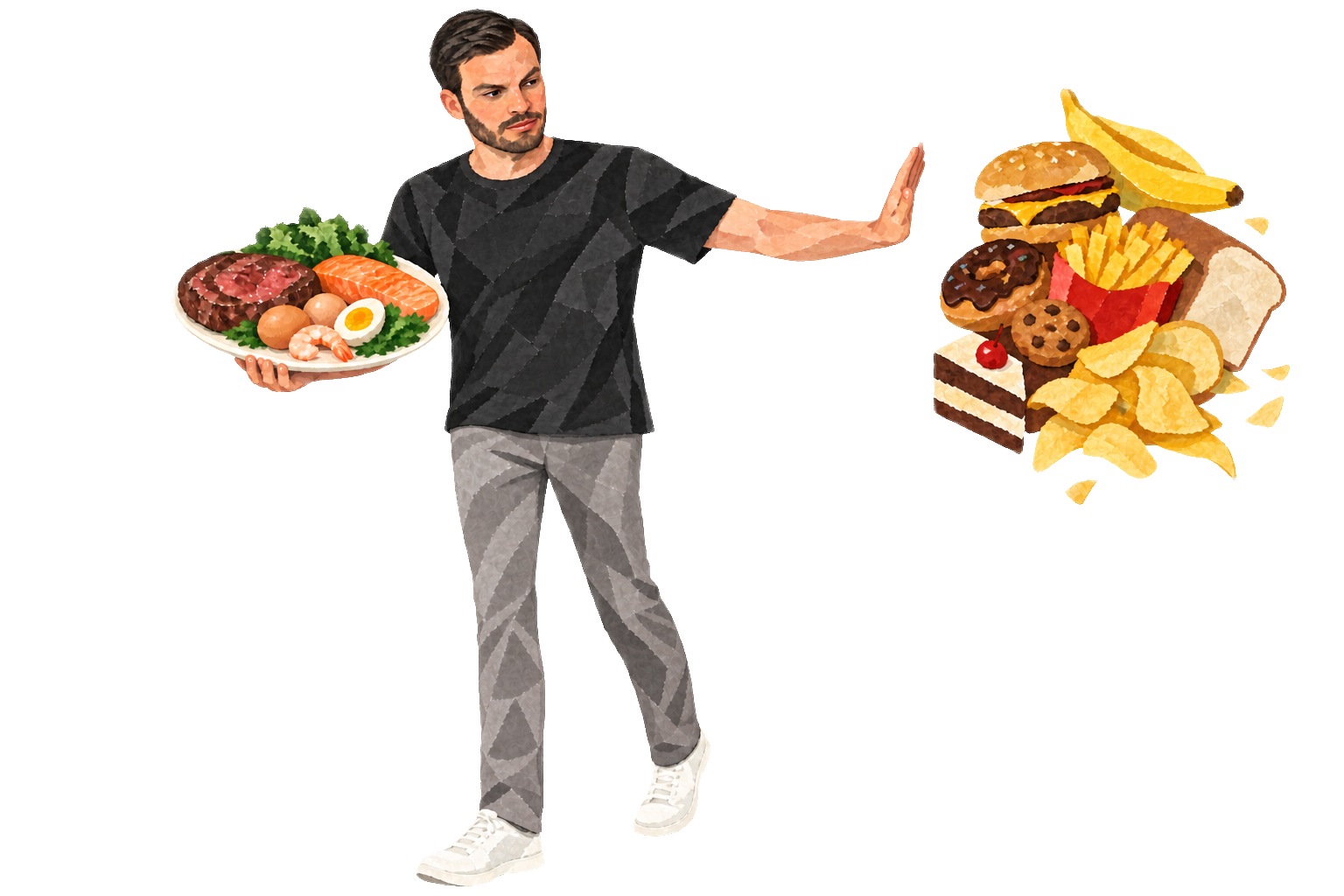
When most of what you eat is energy, your body tends to store more energy. When you prioritize protein, you give it the building blocks for lean tissue. This is the basic principle of Ted Naiman's book The P:E diet and the basic idea is simple.
The ratio of energy to protein on your plate and on your body are related. There are exceptions, but this is a useful way to think about how food influences body composition. Especially when the energy, the fats and carbs, is processed.
Foods contain different combinations of carbohydrates, fats, and protein: the three macronutrients. Carbs and fats are dietary energy, your body burns them for fuel and stores the rest of it as body fat. Protein is the building block of your body.
If your meals have a high ratio of dietary energy compared to protein, your body will have a high ratio of dietary energy in the form of body fat. If your meals have a high ratio of dietary protein compared to energy, your body will have a high ratio of dietary protein in the form of muscle mass and other lean tissue.
We are wired to eat enough protein, because it's essential for survival and regulates satiety. Your body relies on it to build and repair tissue. What matters here is how much energy comes along with that protein, because it affects how much body fat you store.
Naiman calls this the protein to energy ratio, or P:E ratio, which should optimally be around 1.0.
The formula of the P:E ratio is as follows:
Protein (grams) / Fat (grams) + Carbs (grams, excluding fiber)
Here are some examples of P:E ratios in common foods:
- Shrimps (100 grams) : 20,5 grams of protein / 0,6 grams of fat + 0,0 grams of carbs = 34,2
- Chicken (100 grams) : 26,7 grams of protein / 3,1 grams of fat + 0,0 grams of carbs = 8,6
- Steak (100 grams) : 26 grams of protein / 14,5 grams of fat + 0,0 grams of carbs = 1,8
- Salmon (100 grams) : 41 grams of protein / 26,3 grams of fat + 0,0 grams of carbs = 1,6
- Eggs (100 grams) : 12.4 grams of protein / 9,5 grams of fat + 0,7 grams of carbs - 1,2 grams of fiber = 1,4
- Cheese (100 grams) : 24,8 grams of protein / 33 grams of fat + 0,5 grams of carbs = 0,8
- Broccoli (100 grams) : 4 grams of protein / 0,0 grams of fat + 7,3 grams of carbs - 1,2 grams of fiber = 0,7
- Milk (100 milliliters) : 3,5 grams of protein / 3,5 grams of fat + 6,3 grams of carbs = 0,4
- Potatoes (100 grams) : 2,4 grams of protein / 0,0 grams of fat + 11,2 grams of carbs + 1,8 grams of fiber = 0,3
- Bread (100 grams) : 9 grams of protein / 3 grams of fat + 40 grams of carbs - 6,3 grams of fiber = 0,3
- Nuts (100 grams) : 14,4 grams of protein / 69,0 grams of fat + 3,0 grams of carbs + 6,4 grams of fiber = 0,2
- Banana (100 grams) : 1,7 grams of protein / 0,1 grams of fat + 19,8 grams of carbs + 2,7 grams of fiber = 0,1
- Olive oil (100 milliliters): 0 grams of protein / 91,9 grams of fat + 0,0 grams of carbs = 0,0
You may notice that animal foods tend to have great P:E ratios, while plant foods tend to have poor ones. Getting enough protein without also consuming a lot of energy can be difficult if you’re vegan (or being malnourished). Vegetarians don't have this problem as they tend to eat eggs, fish and dairy.
Fats vs. carbs
In this approach, protein should make up about half the grams of macronutrients you eat. The other half can be energy (carbs or fats), as you already carry enough energy on your body in the form of body fat. You should eat for nutrition in the first place, not for energy.
Most people's body fat percentage is too high, carrying so many calories on their bodies that it would take a couple of months until they're out of energy.
The energy grams can be high fat/low carb or high carb/low fat, both might work.
Foods high in both fat and carbohydrates can be especially easy to overeat, because this combination doesn't exist in nature. Imagine eating a potato or drinking a cup of olive oil, you'll get enough of it pretty soon. Now eat a bag of potato chips, a combination of both, and you can't stop eating until it's empty.
I personally have a strong preference for high fat/low carb for several reasons:
- Fasting is one state in which your body can draw on stored fat. There weren't many carbs available for our ancestors, so we mainly evolved on fat for fuel.
- The body's fat stores are a hundred times larger than its carb stores.
- You only start using body fat for fuel after the body burned all the carbs in the liver. If you eat carbs every few hours, all day, your body never gets to burning body fat for fuel.
- Carbohydrates trigger blood sugar and insulin spikes, which can provoke inflammation. When the blood sugar drops, you get hungry again.
- Fats are important for hormone regulation and the solubility of micronutrients.
- The carb part of a meal often contains cheap fillers with high energy and low nutrition.
- Carbs are not essential for the body. We don't need to eat them to survive.
- You don't experience energy dips when you're metabolically flexible, as the fat energy source is more sustainable.
- You are not dependent on food to perform if you run mainly on fats, and you can fast for 24 hours without any problems.
- Carbs generally occur in plant foods. Almost all of them come with a list of toxins, a plant's survival mechanism.
- When you eat mainly whole foods, you end up eating high fat/low carb automatically.
- Carbs are sugars, sugar is bad for your teeth.
https://twitter.com/AlliNutrition/status/1286709018484867072
Macros
What does this look like in practice?
Take your target body weight (in pounds) and aim for fewer grams of fat and carbohydrates combined than that number, and more grams of protein.
For example, if you want to weigh 80 kilos, that is about 176 pounds. Then you should eat more than 176 grams of protein a day and less than 176 grams of energy.
https://twitter.com/tednaiman/status/946638359199301632
A high fat/low carb diet with this principle will come down to a macronutrient ratio of about 30% protein, 60% fats and 10% carbs.
A high carb/low fat diet with this principle will come down to a macronutrient ratio of about 45% protein, 15% fats and 40% carbs.
This will greatly improve your body composition, which is not just a vanity metric. A lower body fat percentage improves your insulin sensitivity, which is the most important factor for a great series of chronic diseases. You can achieve this by having less body fat or more muscle mass (or both, ideally), so weight training will help, too.
Of course, when you do a lot of high intensity exercise, you can add energy to taste.
If you want to explore the P:E diet further, you can follow Ted Naiman on Twitter.
I see you thinking; but isn't eating animal products bad for the planet? No, but the overfat pandemic and all the medicines needed to cure the consequences are.