
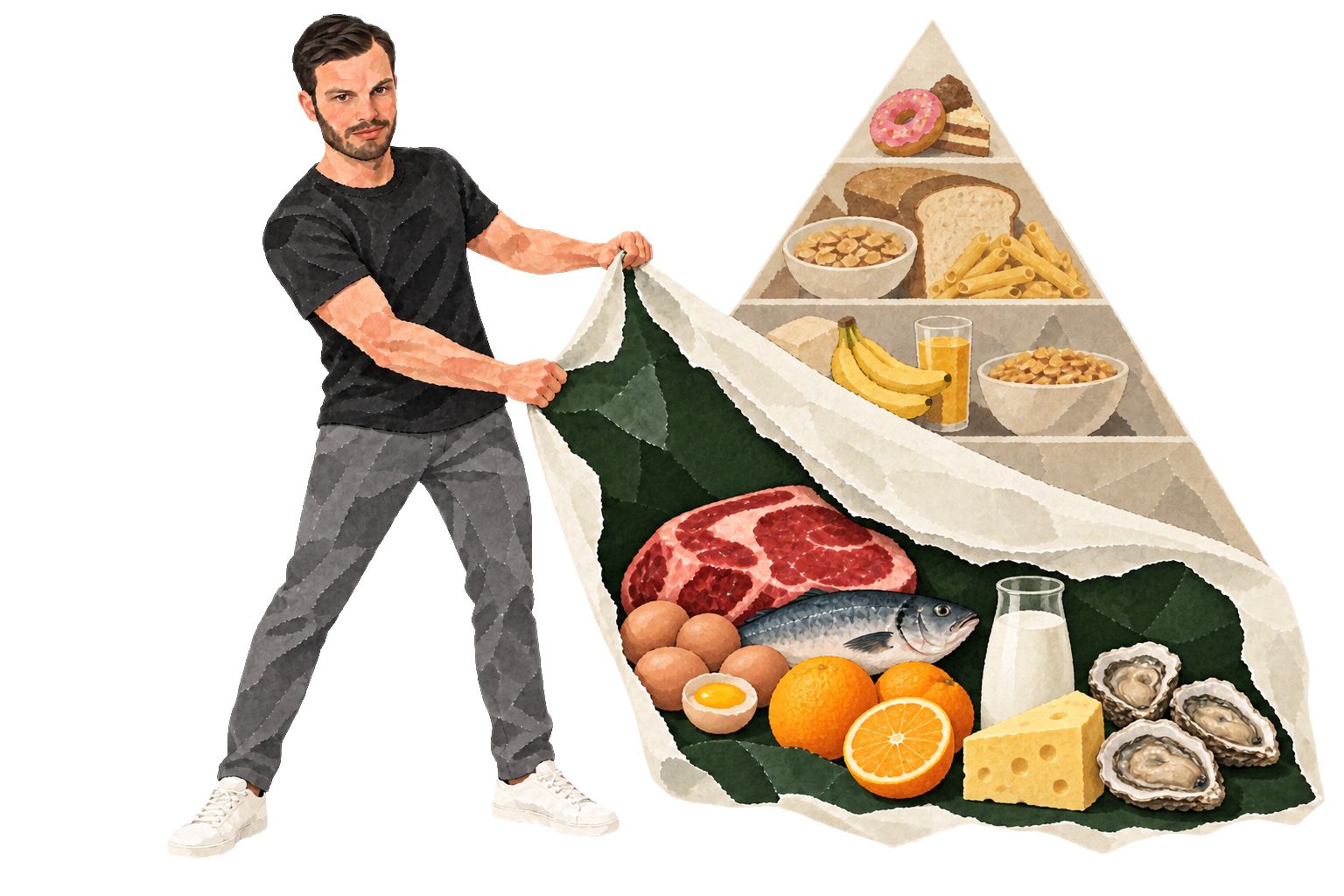
Consensus in science is often driven by factors that have nothing to do with science, like money. This is no different in nutrition. If we hear something often enough, such as "fat is bad for you", we start to assume it’s a fact, regardless of what evidence says.
https://twitter.com/gijsheerkens/status/1216310843262033920
Recently, I had my bloodwork done as a routine checkup. When I got the results, I was shocked by the nutrition advice my GP gave me. Eat less meat and fewer eggs, and eat more grains (LOL).
That conversation convinced me to research health claims myself rather than accept advice uncritically, and to pay attention to how I feel. Humans have eaten meat and spent time in the sun for a very long time, so I wanted to understand why both were now treated as threats.
Luckily I had already read several books on this topic before that appointment, including Lies My Doctor Told Me by Ken Berry. Berry is a physician himself.
Most doctors receive limited training in nutrition and work under considerable time pressure. They may not have time to examine who funded every study behind a treatment recommendation. You may wonder how much skin in the game he has.
Unfortunately, most medical research, especially nutrition research, can be funded by the food or pharmaceutical industry, creating incentives that deserve scrutiny. Those industries have a financial interest in the results.
Researchers can also interpret findings through the lens of what they expect or hope to find. Conclusions may reflect the interests of a sponsoring Big Pharma or Big Food company.
Doctors may have learned from research shaped by these incentives and may struggle to keep up with new studies. The system rarely rewards them for questioning established guidance. Repetition can make even a weak claim sound certain.
In this article I will give you ten pieces of mainstream nutrition advice I’ve questioned over the past few years and will link to my sources: articles and books that discuss meta-analysis (statistical analysis that combines the results of multiple scientific studies), not on one biased study. This is an overview. I plan to write about each topic separately and link those articles here.
I think it is worth asking what we can learn from the diets and habits of our ancestors. I’ve become skeptical of some mainstream nutrition dogma, including the food pyramid presents as a universal guide.
The lies:
- They say fat is bad for you.
- They say cholesterol is bad for you.
- They say meat is bad for you.
- They say eggs are bad for you.
- They say salt is bad for you.
- They say sun is bad for you.
- They say fiber is good for you.
- They say grains are good for you.
- They say fruit is good for you.
- They say skipping breakfast is bad for you.
Truth 1: Fat is the best energy source
Eating fat doesn't make you fat. Fat is important for nutrient transport and absorption, and as an energy source. This makes it an essential macronutrient. It is also satisfying, which may help prevent overeating.
A hundred years ago, everyone cooked with animal fats like lard and tallow. At that time, heart attacks were unheard of in patients younger than seventy and obesity was very rare. Now that we cook everything in toxic vegetable oils, obesity is rampant and heart attack and stroke are the leading causes of death.
Our ancestors made use of available fat. It was usually the first thing they ate. For thousands of years, humans ate greens, protein, and fat, rather than modern products such as fruit juice and skimmed milk.
When you mainly burn fat for fuel you avoid the constant insulin spikes that come along with eating carbs, causing energy dips and brain fog. When you mainly eat carbohydrates, like most of us, you will never get in the fasted state and never burn body fat for fuel because our bodies first deplete carbs before starting to burn fats.
Our ancestors were hunter-gatherers and almost never ate carbs (only fruits and nuts sporadically). Fat is the preferred fuel for human metabolism. When your body adapts to using fat for fuel, you don't have to eat every few hours because you feel weak or hungry. Your body gets used to be in the fasted state. This is the solution to avoid overeating, which is the root cause of a lot of chronic diseases.
Animal fats such as meat, fish and butter, and plant fats such as avocado, olive oil and nuts are very healthy. But industrial vegetable oils on the other hand, such as sunflower oil, canola oil and soy oil are a highly processed food and foods I try to avoid because of concerns about oxidation and how long they takes years for the body to cleanse them.
The Big Fat Surprise by Nina Teicholz and Deep Nutrition by Catherine Shanahan are great books on this topic.
Truth 2: Cholesterol doesn't clog your arteries
Cholesterol is essential for your body to function. It's one of the most beneficial molecules for your health. We are told to lower our cholesterol, but this advice is killing us. Higher cholesterol is associated with longer life.
The cholesterol story strikes me as an example of medical research going wrong, paid for by Big Food in the seventies. Fifty years later, its influence remains visible in nutrition advice.
Cholesterol is very complicated, a vital part of your body and the building block for your hormones. It may be present in clogged arteries as part of the response to damage caused by inflammation and save you.
I question the idea that higher cholesterol always means higher heart-disease risk. Studies found an inverse relationship between all-cause mortality and cholesterol levels. That makes blanket advice to reduce cholesterol seem too simple to me.
Cholesterol is an organic molecule produced in all the cells of the body. The liver produces most of the daily cholesterol. It makes up 30% of the cell membranes and is used to build and maintain them. It enables the body’s production of Vitamin D and steroids, hormones and more. It also helps with transport and signaling between cells.
I worry that fear of cholesterol encourages people to choose vegetable oils, which I consider actually killing you.
The Great Cholesterol Myth by Jonny Bowden is a great book on this topic.
Truth 3: Red meat is a superfood
Meat tastes good, provides a range of nutrients, and can help support body composition.
Meat doesn't cause cancer. Red meat is a nutrient-dense food, filled with vitamins, minerals, protein and healthy fats. Not a single controlled study proves any link between eating red meat and a significant increased cancer risk.
Humans have been eating red meat for millions of years. Our brain size increased to its current size because of the quantities of fatty red meat our ancestors consumed. Given that long history, I’m skeptical of sweeping claims that red meat is inherently harmful.
Even processed meat, such as bacon and hot dogs, isn't unhealthy. It contains fewer nitrates and nitrites than many vegetables, and these compounds have not been definitively shown to increase cancer risk, and I have not seen controlled trials that establish this claim.
Your body naturally produces hundreds of times more nitrites in your saliva each day than you could possibly get if you ate nothing but processed meat all day.
The Carnivore Diet by Shawn Baker is a great book on this topic.
Truth 4: Three eggs a day keep the doctor away
The persistent myth that cholesterol causes heart disease has scared many of us away from eating eggs on a regular basis. But there is absolutely no research that links egg consumption to heart disease.
One of the worst things you can do when trying to eat well, in my view, is to stop eating eggs, and start eating products advertised as healthy instead. If they have to advertise that it's healthy, I become skeptical of the claim. It may not be healthy at all.
Eggs are one of the most nutrient-dense foods available. One egg provides 13 essential nutrients, including vitamins A, B, D and E, iodine and phosphorus.
Eating eggs improves cardiometabolic markers like insulin sensitivity and lipid markers. There’s absolutely no reason to limit your consumption to three to four per week. It’s important, however, to make sure that you buy organic, pasture-raised eggs, coded with a 0 in Europe.
Truth 5: Salt regulates hydration and satiety
Salt is not bad for you at all. It's an essential mineral. Many people associate salt with processed food which has damaged its reputation.
For all our existence on this planet we have loved salt and have eaten as much as we wanted or could find. Our bodies can regulate salt intake, much as they regulate water intake. Salt regulates hydration and signals satiety.
The more sodium people ate, the less likely they were to die from heart disease. Salt had virtually no impact on blood pressure, which is caused by insulin resistance. Unless you have poor kidney function or significant heart failure, you’re free to relax your fears and eat salt to taste on all your food.
The Salt Fix by James DiNicolantonio is a great book on this topic.
Truth 6: The sun is a magic fireball
Humans have played and worked in the sunshine for many thousands of years. Our skin has adapted to sunlight over a long period of time.
In the last forty years, some of the smartest among us have discovered that the very thing that makes all life on this planet possible is now also the leading cause of skin cancer.
Sunshine actually reduces certain kinds of skin cancer, as well as cancer in other parts of the body. Living further from the equator is a risk factor for skin cancer and other types of cancers.
Your skin is made of what you eat and completely replaced with new cells every month or two. The nutrients we eat help build those new cells, for better or worse. Eating quality natural foods would help you build better skin that is less likely to burn or be damaged.
Doctors and dermatologists keep telling us to stay out of the sun and put poisonous sunscreen on our biggest organ to protect ourselves. This is another great example of via negativa gone wrong. Instead of adding sunscreen and all the toxic chemicals it contains, it’s better to adjust your sun exposure to your personal situation.
Our skin can adapt to small amounts of stress (hormesis). If your skin can handle 15 minutes of sun exposure today it will get stronger afterwards and can probably handle 16 minutes tomorrow.
Truth 7: There is no need to eat fiber
The minimum fiber intake you need is 0 grams. In fact, many studies have demonstrated that excess intake of fiber may actually be harmful, particularly for gut health.
The need for fiber was first invented by John Kellogg from the breakfast cereal company.
Fiber is an indigestible product for the body and provokes constipation because it bulks the stool. Bloating and belching are common symptoms. I question whether more fiber is always useful. Fiber slows digestion, which can be helpful for some people but uncomfortable for others.
Fiber can help you to feel satiated earlier because of the bigger bulk. Fiber is often recommended because it can blunt blood-sugar spikes, but if you don't eat foods that provoke those spikes in the first place there is no need to bother your digestive system with useless load (via negativa again). It's better to eat less carbs anyway.
Fiber may cause bowel problems because some sources contain FODMAPs, a wide category of fibers that cause digestive symptoms, including gas and abdominal pain, in many people.
Fiber Menace by Konstantin Monastyrsky is a great book on this topic.
Truth 8: Grains are cheap fillers with few nutrients
Grains such as bread, cereals, pasta and rice are cheap foods loaded with empty calories and carbohydrates, that provoke blood sugar spikes while providing relatively few nutrients. This makes you hungry again when the blood sugar drops, leading to overeating. Whole grains spike insulin almost as much as refined grains.
Food companies and health institutions basically made the population sick by advising to get the majority of calories from "heart healthy grains". In the long run, this leads to insulin resistance because of overeating (good for Big Food) and sick people (good for Big Pharma).
Wheat Belly by William Davis is a great book on this topic.
Truth 9: Fruits are sugar bombs
It seems obvious that fruit belongs in a healthy diet.
But fruits are loaded with sugars without containing a lot of vitamins and minerals. Something that causes insulin spikes is not a healthy snack, and there are better sources of vitamin C to be found.
Bananas contain about 93% of calories as carbohydrates, most of that sugar. Apples and pears are similar in composition. Berries, like blueberries, strawberries and raspberries, are an exception because they are lower in sugar.
Drinking fruit juice is a different matter. A glass of orange juice contains as much sugar as a can of soda, which is why I avoid treating it as a health drink.
Truth 10: Fasting is the best diet of all
Intermittent fasting is one approach to limiting how often we eat. When you eat in a pattern that cycles between periods of fasting and eating, you may eat fewer calories because meals feel more satisfying.
It can have many benefits for your body and brain if your body doesn’t have to process food all the time. The easiest way to achieve an 8 to 10 eating hour window is by skipping breakfast. This improves insulin resistance, blood sugar regulation, stress resistance, hypertension and inflammation among others.
But when we skip breakfast, we are eating less and there is less food to sell. That may help explain why the advice to never skip it persists.
The P:E Diet by Ted Naiman is a great book on this topic.